
What Is an In-Line Warehouse Layout?
An in-line warehouse flow, also known as a straight-through flow, is a layout configuration where inbound and outbound
areas are positioned on opposite sides of the warehouse. Goods move in a linear direction from receiving to
shipping without backtracking.
This flow is designed for high-volume operations that require clear separation between inbound and outbound activities.
How the In-Line Flow Works
In an in-line layout:
- Goods enter the warehouse through inbound docks
- Items move progressively through storage or picking areas
- Order preparation occurs along the flow path
- Completed orders exit through outbound docks on the opposite side
The movement follows a straight, forward direction, reducing cross-traffic.
Advantages of an In-Line Warehouse Flow
Key advantages include:
- clear separation of inbound and outbound traffic
- reduced congestion near docks
- high throughput capability
- efficient handling of large volumes
- easier scaling for growth
- improved safety and visibility
This flow is common in distribution centers and large warehouses.
Limitations and Constraints
Despite its strengths, the in-line flow has limitations:
- longer travel distances compared to compact layouts
- higher space requirements
- less flexibility in small buildings
- increased walking for picking operations
It is not always suitable for constrained or low-volume environments.
In-Line Flow vs U-Shaped Flow
- In-Line Flow – linear, scalable, high throughput
- U-Shaped Flow – compact, flexible, short travel distances
The optimal choice depends on volume, space, and operational complexity.
When to Use an In-Line Flow
An in-line warehouse flow is recommended when:
- inbound and outbound volumes are high
- product range is large
- building length supports linear movement
- operations require strong separation of activities
- future growth is expected
It is less effective in small or space-constrained warehouses.
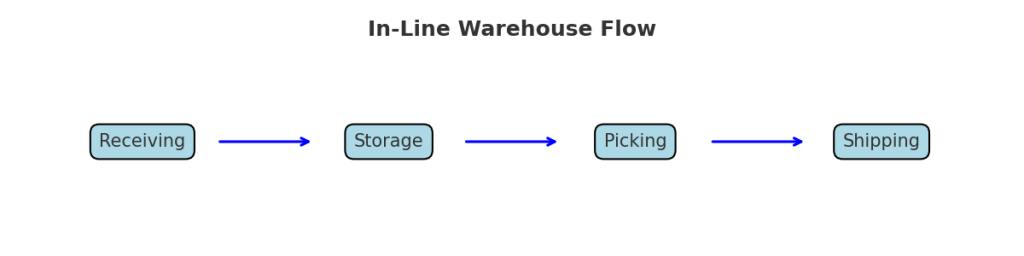
Example of In-Line Material Flow
- Goods are received at one end of the warehouse.
- Items move through inspection and storage zones.
- Orders are picked and moved toward the opposite side.
- Packed goods are shipped directly from the outbound dock.
This design forms a straight material flow — ideal for manufacturing facilities or warehouses with
separated inbound/outbound docks.
Comparison With U-Shaped Layout
| Aspect | In-Line Layout | U-Shaped Layout |
|---|---|---|
| Flow Direction | Straight | Circular (U pattern) |
| Dock Configuration | Separate inbound/outbound | Shared inbound/outbound |
| Space Requirement | Higher | Compact |
| Travel Distance | Longer | Shorter |
| Best For | Linear buildings | High-throughput warehouses |
FAQ – In-Line Warehouse Flow
Why is the in-line flow used in large warehouses?
Because it supports high volumes and clear separation of activities.
Does in-line flow reduce congestion?
Yes, especially around docks and main traffic areas.
Is in-line flow suitable for e-commerce?
Yes, particularly for high-volume fulfillment centers.
Can in-line flow be combined with zoning?
Yes. ABC zoning is often applied along the flow path.
Is automation required for in-line flow?
No, but it is often easier to automate compared to compact layouts.