
What Is the Replenishment Process in a Warehouse?
Replenishment is the process of moving inventory from bulk or reserve storage locations to forward picking locations
in order to maintain product availability for order fulfillment.
Unlike receiving or put-away, replenishment is a continuous internal process that directly supports picking
efficiency and service level.
Standard Replenishment Process – Step by Step
A typical warehouse replenishment process includes:
- Replenishment Trigger
A minimum stock level, reorder point, or picking location threshold is reached. - Replenishment Task Creation
A task is generated manually or automatically to move stock. - Source Location Selection
Inventory is selected from bulk or reserve storage. - Movement Execution
Stock is physically moved to the picking location. - Quantity Verification
Transferred quantities are checked for accuracy. - Stock Update
Inventory records are updated to reflect the movement.
This structured flow prevents stockouts and picking interruptions.
Replenishment vs Put-Away
Although both involve internal stock movement, they serve different purposes:
- Put-away moves received goods into storage locations
- Replenishment moves stored goods into picking locations
Put-away happens after receiving; replenishment happens continuously during operations.
Operational Best Practices for Replenishment
To improve replenishment efficiency:
- Separate replenishment tasks from picking routes
- Schedule replenishment during low picking activity
- Use minimum and maximum levels for picking locations
- Avoid emergency replenishment whenever possible
- Keep clear identification of bulk and picking zones
- Standardize replenishment quantities
- Record every movement accurately
Well-managed replenishment reduces picking delays and operator congestion.
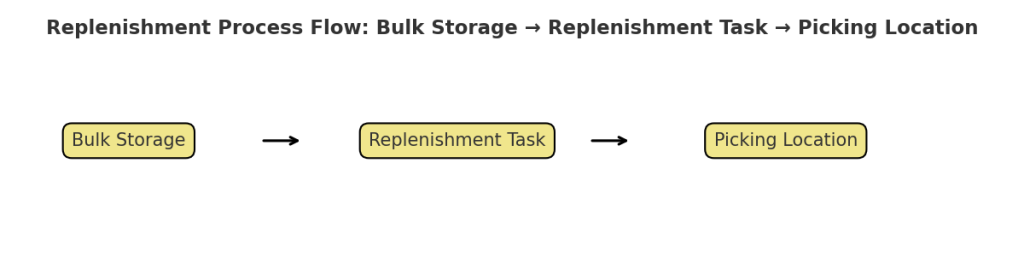
Replenishment and Warehouse Layout
Replenishment efficiency depends heavily on layout design:
- Bulk storage should be close to picking zones
- Clear ABC zoning reduces travel distance
- U-shaped and compact layouts simplify replenishment paths
- Location coding must distinguish bulk vs picking
A poor layout increases replenishment time and operational friction.
FAQ – Replenishment Process in Warehouse Operations
When should replenishment be triggered?
When picking stock reaches a predefined minimum level.
Should replenishment and picking happen simultaneously?
Ideally no. Separating them reduces congestion and errors.
Is replenishment necessary in small warehouses?
Yes. Even small operations benefit from structured replenishment rules.
Can replenishment be done manually without a WMS?
Yes. Clear rules and accurate stock data are sufficient.
How does replenishment affect picking performance?
Efficient replenishment prevents stockouts and picking interruptions.
Related Tools and Pages
Din acest articol trebuie să existe link către: